
by Brian Hodges
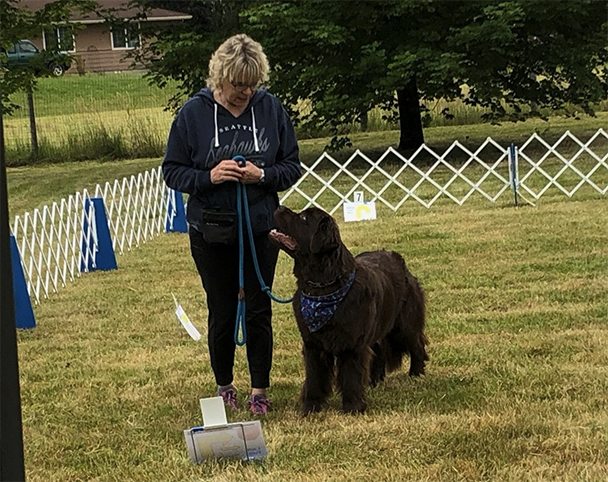 Imagine, if you will, that you are showing your dog in competition obedience. The first time you were in the ring, you qualified like pros, finishing in the ribbons. This time, however, it’s a total disaster. During the off-lead heeling exercise the handler in the next ring tossed her dumbbell. Your dog leaves heel position and runs across the ring to get the toy. A few moments later, you are explaining to the judge and anyone who will listen, “My dog has never done that before.”
You are not alone. Sometimes, our dogs invent new (and often wrong) ways of doing a task. At other times, the dog will do something wrong because it never truly understood what was being asked of him or her. And still at other times, the dog (or handler) checks out under the stress of competition. Thus, the phrase, “my dog has never done that before” is one of the most commonly heard sayings at an obedience trial. Indeed, mistakes hit newbies and old pros alike. Understanding why our dogs make mistakes and having a strategy for addressing them is one of the keys to success in the ring.
Many mistakes are attributable to entering the ring before the dog truly understands what is expected of him or her. Put simply, competition obedience is about getting your dog to exhibit learned behaviors in response to certain cues in a variety of locations and under variable circumstances. Typically, however, it takes dogs a while to generalize trained behaviors. That means that, if a dog learns a behavior like heeling in a one environment, the dog may have a hard time understanding the same cue in a different environment. For example, your dog may heel beautifully in your training facility, but falls apart when asked to heel outside. That’s to be expected. The dog isn’t being bad or disobedient; it just hasn’t had enough experience to generalize the heeling behavior outside its training grounds.
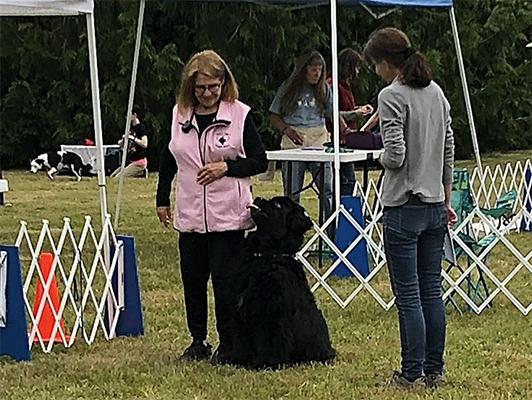 The answer to the generalization problem is easy: take it on the road. Teaching a dog a new behavior is relatively easy. The most time consuming part of training is achieving consistency in the dog’s response to a cue in a variety of circumstances. In order for dogs to understand that a certain command means the same thing all the time, handlers must teach the cue in different locations. Teach it at home, in the park, near a busy street, in a parking lot, in a shopping mall, a gas station, a basketball court, near a school, near a lake, near the Dog Park, etc.—i.e., proofing the exercise.
“It is arguably impossible to evaluate whether your dog is ready for the ring unless and until you take it on the road.”
Mistakes are essential during the process of proofing your dog. In fact, they function as markers on your roadmap to success. That is because it is arguably impossible to evaluate whether your dog is ready for the ring unless and until you take it on the road. Take, for example, the Utility go-out exercise, which requires the dog to run and sit directly across the ring on command. Handlers often train this exercise using targets, giving the dog a treat when it reaches its mark, and then eventually eliminating the target. But dogs are associative learners (meaning that they acquire new knowledge based on making connections between events and sensory cues). And their learning process is driven by cause and effect—i.e., creating a positive consequence as a reward for good behavior. So, until you practice the go-out away from your training facility, how are you to know whether the dog is associating treats with the targeted area and not a ring gate, a beam, a pink dot on the wall, a different colored ring mat, etc.
Training in new locations and under different circumstances will eliminate the variables that the dog could be associating with the cue/learned behavior, and thereby showing you whether your dog is associating the right behavior with the right cues.
Training isn’t always about getting it right all the time. Your dog has to make mistakes in order to learn. That’s where attending fun matches (practice dog shows, often put on by training clubs) can be one of the most useful tools in a trainer’s bag-of-tricks. Whether you are a first time handler or a pro team, there is much to be learned at every fun match. Most obviously, fun matches give the team an opportunity to generalize learned behaviors in changing show-like environments.
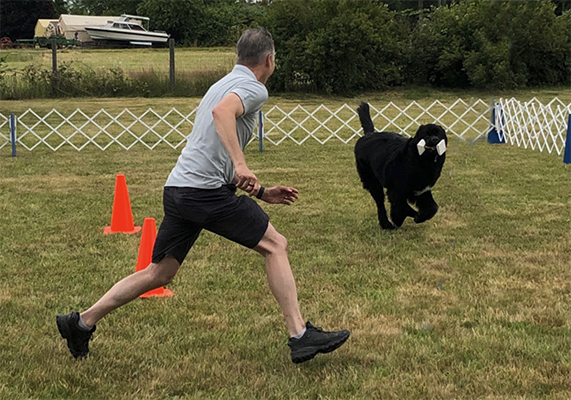 Sure, a flawless run can be a real confidence booster and help in evaluating your dog’s readiness. And there is no debating how important that boost can be for a team.
But to get the most from a fun match, you shouldn’t go into a match—with all of its enticing sights, sounds, and smells— hoping only to see perfection. If you do so, you may miss opportunities to grow your team. Suppose your dog pays more attention to other people and dogs than you or sniffs the floors, use the match as an opportunity to work on the dog’s focus—who cares about performing all of the exercises? Your dog has just told you that it hasn’t generalized its attention behavior to a distracting environment.
So, here’s to all the new mistakes, the weird mistakes, the befuddling mistakes you and your dog will make because each one of those mistakes is a lesson whose reward is the deep connection and fun that comes from training a competition obedience dog. And the next time you find yourself uttering that dreaded phrase, “my dog has never done that before” (hopefully at a match), smile and know that each mistake is an opportunity for your relationship with your dog to grow.
reprinted from NewfTide 2014