
by Ann Lapeyre
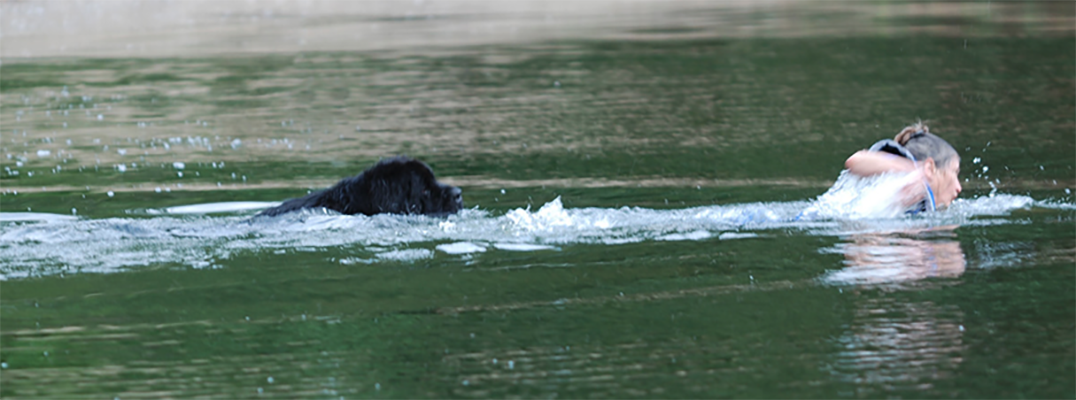
When water training or testing, you might run into a real life situation with a child nearby playing with an intriguing toy or eating food. If you’ve trained for situations like that, making certain your dog understands that “Rover, Come!” indeed means “Come!”—on the first command, every time, no matter what’s going on around you—you’ll have a reliable recall. When calling our dog, we say “Rover, Come!” But we don’t want him to anticipate and come on his name, so we “proof” for that. Sometimes we’ll say “Rover….Stay!” We praise and reward the stay. If he anticipates, we don’t get upset, but calmly put him back in place and may help him by saying “Stay…..Rover…..Stay.” He gets lots of praise when he stays. Don’t underestimate what your Newf can do; they can be quick, accurate, happy working dogs.
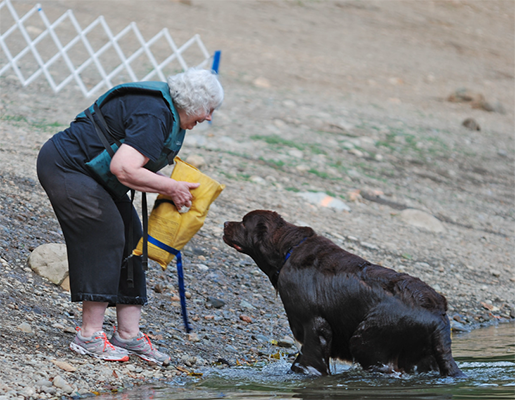 We don’t want our dog to anticipate a retrieve, so we “proof” for that. He must sit in heel position until he’s given his retrieve command, “Rover, Fetch!” If he wants to anticipate and leave on his name, he’s restrained (a pull tab is handy in this instance). The next time we might say, “Wait, Rover, Wait. Good wait!” Praise and reward the wait.
We do plenty of proofing for water tests with our dogs. Listed below are some suggestions for “water proofing” (not a complete listing) that have helped many dogs. Be creative, but also be reasonable. A seasoned dog can handle more challenging proofing than a learning dog. Help the inexperienced dog be successful, but ensure things happen correctly (i.e., go directly to the calling steward) and prevent bad habits from developing.
A long line is vital for proofing exercises
Break exercises into small parts in training, gradually putting those parts together for the finished product. We’ve learned not to avoid training problems, but to tackle them head on. If you avoid the problems, as one friend says “They’ll come back to bite you in the butt,” at the worst time, in the ring or at a test. Dogs that can easily handle challenging training sessions are well prepared for a test, but keep in mind there is always the unexpected.
Suggestions for “water proofing.”
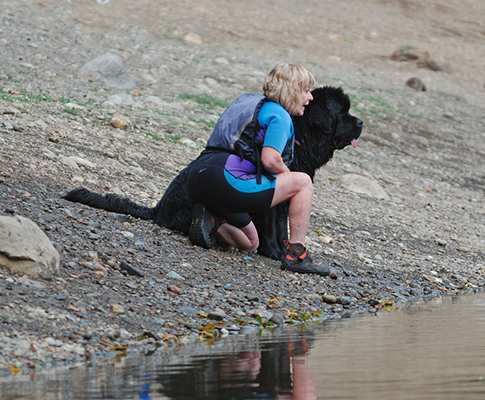 · Ensure the dog goes directly to the article, person, boat, etc., on the first time/first command without pleading with the dog. We learned many years ago, if a dog doesn’t go promptly and directly, then you take them all the way, not part way, to the article or person. No second chance to turn around is allowed. (Thank you, Sandee and Mike Lovett, for all your words of wisdom at a water workshop we attended many years ago: “If you have to take your dog to the steward, you go out there and shake hands with the steward.”) Consistency on your part will equal consistency on the dog’s part.
· When training at the same location, introduce different situations by varying points of entry, distances to swimming depth, distractions, beach versus grass, view on the opposite shore, etc. During a test pre-swim, have the dog enter the water from different points on the beach.
· Train with different stewards—men, women, children; people wearing hats, sunglasses; people with different calling voices; different splashing styles, etc. You’d be amazed at how many non-Newf people enjoy being rescued. Some training should be done with stewards who are complete strangers; don’t let them meet the dog until after being rescued.
· Vary distances. Sometimes have the dog swim farther than required in a test (farther from shore, articles farther apart from each other, farther from the boat, etc.). Sometimes have things happen at shorter distances. (Things may float farther away from or closer to shore, or to each other.) For the Senior double retrieve, sometimes have articles much closer together than in a test, sometimes much farther apart.
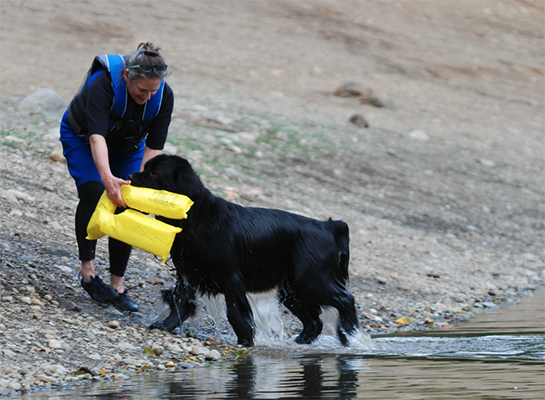
· Make certain the dog will pick up everything he’s expected to retrieve, whether in the water, at swimming or standing depth, or on land; also make certain he’ll retrieve on the first command and promptly deliver to hand. For consistency, our dogs deliver everything to hand, even when not required. When the dog takes a line or life ring to a steward, and tows a boat, our dogs deliver those lines to hand, even if it means the handler goes to the dog (i.e., once the boat is beached, etc.).
· Practice with a crowd on shore. At a test there will be multiple stewards, two judges, etc. Have people move around, cheer, clap, etc.
 · Accustom the dog to a whistle, as one will be used at a test.
· Vary practice conditions: time of day, rain, wind, sun, retrieves into sun, etc. At a test, may want to consider moving to a different position on the beach, if possible, so the dog is not swimming directly into the sun.
· Train the dog to promptly heel down the beach with distractions. There is often a more advantageous area from which to send the dog than the beach center.
· Practice directed retrieves, blind retrieves, retrieves into the sun. Make sure the dog is focused on the direction you’re pointing.
· For the Underwater Retrieve, practice in water slightly deeper than required and in clear and murky water. If the dog paws the article, make sure he goes towards the beach, not into deeper water or parallel to shore.
· Practice with distance markers; teach the dog to retrieve items adjacent to the marker. During a test pre-swim, show your dog the markers. Ensure the dog understands they are to be ignored. Toss your bumper near the marker.
· Practice Tow-A-Boat with different stewards and with stewards in varying positions—at bow and stern, lying and sitting on platform, feet in water, different calling styles.
· Do not allow anticipation for anything, retrieves, jumping from boat, etc. We don’t allow anticipation on the single retrieve since it’s not allowed on any other exercise. Be clear and consistent. Sometimes reward the wait/stay.
· For Tow-A-Boat, make sure the boat is beached and have the bumper delivered to hand (handler will have to approach the dog) since it is required in other exercises.
· Ensure the dog goes all the way in every exercise: right up to the boat, around the steward, etc. The dog isn’t required to go around the drowning steward, but if done consistently in training, hopefully if he cuts it short at a test, he’ll still be close enough for the steward to reach the line, life ring, or dog.
· Practice basic control.
· Land work can be very helpful both for teaching exercises as well as proofing.
· Consistency in training yields consistent test performance.
· Read the rules!
A bumper is integral for training - buy them in bulk!
Practice good sportsmanship and clean handling. Don’t take it out on the dog if he makes a mistake. As we were told at that first water workshop so many years ago, “Don’t do it for the title at the end; do it for the journey along the way.” We’ve had some incredible journeys along the way. Both you and your dog should enjoy the journey.
Test conditions vary and include these varying scenarios in training. When the dog knows and understands the exercise, don’t make training easy, but challenge him to do all the exercises with distractions and varying conditions. Making it harder in training will make a test seem easy. You and your Newfoundland will both be comfortable and confident handling situations that arise.
Happy Swimming!